Online Competitions in scoreio: Run Events Remotely
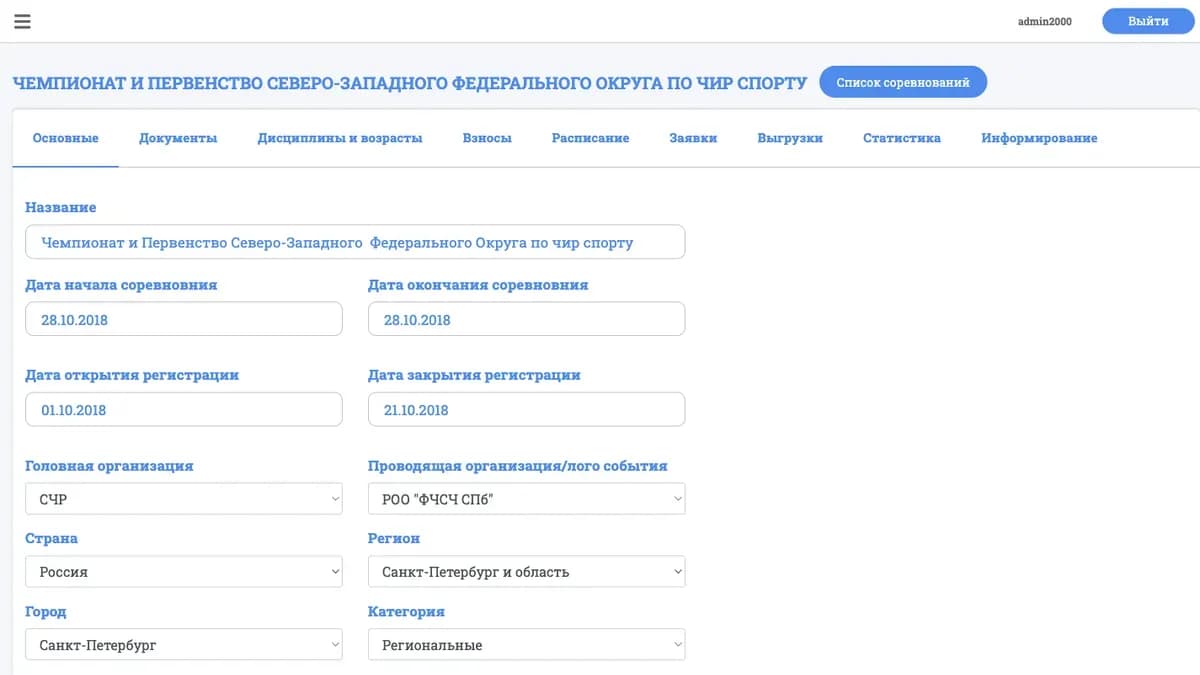
When an in-person tournament can't be held, an organizing committee has two paths: cancel the season or move it to a remote format. The first option hits the teams, the athletes and the federation itself — a year of training without a single event devalues everyone's work. So we added support for online competitions to scoreio: a format where both registration intake and the event itself happen remotely, and the season carries on no matter what.
How it used to be
The platform was originally designed for in-person tournaments. A team registers, travels, takes the mat, judges score it live. Everything around that event — registrations, line-ups, the schedule, statuses — worked for exactly that model.
When mass in-person events became impossible, organizers faced a choice with no good options. Moving a tournament online "on a shoestring" meant collecting performance videos by email and in cloud folders, keeping parallel participant lists, manually matching recordings to registrations. That dragged the committee back into the chaos of spreadsheets and messaging — the very thing the platform was meant to eliminate.
The core problem wasn't the technique of filming, but that the system didn't distinguish an online start from an in-person one. A competition had no format attribute, and the whole remote process had to be cobbled around the platform rather than inside it.
What changed

We taught scoreio to understand a competition's format. Now an online event is a full, platform-supported mode rather than a workaround.
An online-format attribute on the competition
A competition now has an online-format flag. The organizer marks that the event runs remotely, and the platform takes this into account when working with registrations. An online tournament is the same kind of object as an in-person one, with its own line-up, divisions and statuses.
Online format at the team-registration level
The online-participation attribute exists on a team's registration too. This means that within a single process you can correctly run teams that perform remotely. Their participation is recorded specifically as online — without bending definitions and without separate "shadow" lists.
The season continues on the same base
Most valuable of all — the online format lives in the same system as everything else. Teams, athletes, divisions, registration statuses, notifications — all of it works for remote events too. The committee doesn't need to learn a second tool: the format of running changes, not the platform.
What this gives you

- The season isn't lost. When an in-person start is impossible, the event moves online — teams compete, athletes get results, the federation keeps its calendar.
- One process instead of two. Remote teams are run in the same system as in-person ones, with no parallel lists and no manual matching.
- Correct format tracking. Online participation is recorded explicitly — on both the competition and the registration — so statistics and history stay accurate.
- Familiar tools. Registrations, line-ups, statuses and notifications work as usual. The committee doesn't relearn anything.
- Calendar flexibility. You can plan remote stages where in-person ones can't be held, without breaking the series.
Scenarios where this solves the problem
The in-person start is impossible, but the season goes on. A tournament meant to be the key event of the year can't be held in person. Instead of canceling, the committee marks the competition as online, opens remote registration intake — and teams compete without dropping out of the calendar.
A mixed calendar. The season has both in-person and remote stages. Because format is an attribute of a specific event, the committee runs them in one space: in some, teams travel; in others, they perform online, but the participant base and registration logic are shared.
Teams from different regions. A remote format removes the geographic barrier: squads don't have to travel to take part. The organizer accepts online registrations from teams for whom an in-person trip would be out of reach, and broadens the field.
Frequently asked questions
How does an online competition differ from an in-person one in the system? A competition has an online-format attribute, and so does a team's registration. The platform understands that the event and the participation are remote and accounts for it when handling registrations.
Do I need separate lists for online teams? No. Remote teams live in the same system as in-person ones — without parallel spreadsheets or manual matching.
Do the usual functions work for the online format? Yes. Registrations, line-ups, divisions, statuses and notifications work for remote events too — the format changes, not the platform.
Can I mix in-person and online stages in one season? Yes. Format is set per competition, so a mixed calendar is run in a single space.
Does this help preserve the season? That's exactly why the format was added: when an in-person start can't be held, the event moves online and teams keep competing.
How to get started
Online-format support is about calendar resilience. The season no longer depends on whether everyone can gather in one hall: when needed, an event moves to remote mode while staying in the same system, with the same team base and registration logic. The committee gets to adapt rather than cancel.
So remote teams learn their registration statuses without delay, the notifications center and Telegram notifications come in handy — especially when participants aren't gathered in one hall.
Want to run competitions and accept registrations remotely? Request a demo or a pilot run of scoreio — we'll show you how to move an event to the online format and preserve the season without losing your familiar tools.