Early Bird Registration in scoreio: A Discount for Registering Early
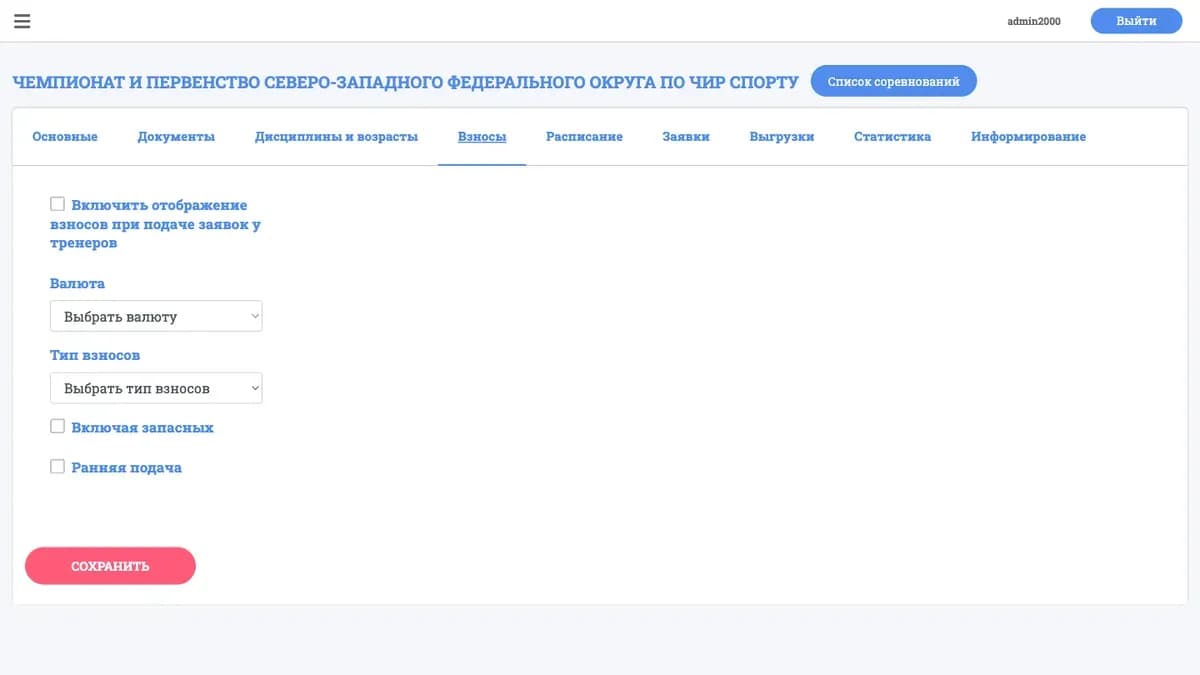
Every organizer knows this pain: half the registrations arrive in the last three days before intake closes. Until that moment the field is a fog — it's unclear how many teams there'll be, how to split flights, what schedule to prepare. Early registration changes this dynamic. We added early bird to scoreio — a reduced fee until a chosen date that motivates teams to submit in advance and gives the committee an early, clear picture of the field.
How it used to be
Participant behavior is highly predictable: as long as there's time to spare, the registration gets put off. "We'll make it," "we'll finalize the line-up," "let's wait closer to the date" — and most registrations fall at the very last moment. For the committee that's the worst case: the load peak coincides with the deadline, and until then planning is done blind.
Fee tracking was already in the platform: payment types, amounts, currency. But the price was static — one amount for the entire registration period, regardless of whether a team registered two months or two hours before close. The organizer had no built-in lever to reward those who register early.
You could, of course, announce a discount "by hand" — verbally, in the regulations, in messages. But then you have to track and apply it yourself: remember who made it before the date, count different amounts, not make mistakes. The discount existed on paper, not in the system.
What changed

We made the fee price time-dependent. Now a payment can have an "early" price that applies until a certain date.
A reduced price until a chosen date
The organizer sets an early bird date and a reduced fee amount that applies until it. Teams that registered in time get the discounted price. After the date passes, the regular price applies. The logic "make it before — pay less" is built into the system itself.
An early-payment attribute on the fee type
Early bird is a property of a payment type. So in a flexible fee model with different payment types, the early price is configured where it's needed and coexists with regular amounts. It's a clean layer on top of the already familiar fee tracking, not a separate mechanism.
A clear deadline incentive
The early registration date acts as a gentle but tangible incentive. A team sees the discount has a deadline, and that shifts the "submit the registration" decision closer to the start of the registration window rather than its end.
What this gives you
- Registrations come earlier. A reduced price until the date shifts the flow of registrations toward the start of the window — the committee understands the field sooner.
- Less uncertainty. An early, predictable field simplifies planning flights, the schedule and logistics.
- An incentive with no manual work. The discount is applied systematically by date — no need to manually track who made it and count different amounts.
- Model flexibility. The early price is configured at the fee-type level and combines with other payment types.
- Transparency for teams. Participants see the benefit of an early registration in advance — it's a fair and clear rule.
Scenarios where this solves the problem
A large tournament with tight planning. The sooner the field is known, the calmer it is to prepare the schedule and split flights. Early bird pulls registrations toward the start of the window, and by the time the program needs laying out, the committee already has a reliable base of teams rather than a scatter of promises.
A series of stages. In a series it matters to understand participation dynamics in advance. An early price at each stage gives a more predictable flow of registrations, and the organizer sees how the season is shaping up without waiting for the last week before each start.
Peak-load control. When some teams register early for the discount, the peak at the deadline gets lower. Intake and processing spread out more evenly over time rather than piling into one overloaded point.
Frequently asked questions
How does early bird work? The organizer sets an early registration date and a reduced fee amount that applies until it. Teams that submit in time pay less; after the date, the regular price applies.
Where is the early price configured? It's an attribute of a payment type. In a flexible fee model, the early price is set on the relevant payment type and combines with regular amounts.
Do I need to manually track who made it before the date? No. The logic is tied to a date inside the system — the discount is applied by rule, without manual tracking.
Why does an organizer need early registration? It shifts the flow of registrations toward the start of the window, so the field becomes clear earlier and planning is easier.
Does early bird work with different fee types? Yes. The early price is configured at the payment-type level and coexists with the competition's other payment types.
How to get started
Early registration is about managing the timing of submissions. A reduced price until a chosen date turns the vague "register early" into a concrete incentive built into the system. Teams respond, the flow of registrations shifts toward the start of the window, and the committee gets what it usually lacks — an early, predictable picture of the field.
Early bird builds on fee tracking and payment types — the early price is configured right there. And so the flow of early registrations isn't lost and teams learn statuses on time, the notifications center and messenger alerts help.
Want to encourage teams to register earlier? Request a demo or a pilot run of scoreio — we'll show you how to set up an early fee price by date and get a clear field well before the start.